International Heritage Centre blog
Richard Slater: The Army's ‘Song Writer Number One’
Richard Slater: The Army's ‘Song Writer Number One’
This guest blog by Dr Gordon Cox is an introduction to Slater and his songs. Dr Cox was formerly Senior Lecturer in Music Education at the University of Reading. He is the author of 'The Musical Salvationist: The World of Richard Slater (1854-1939)'.
Richard Slater (1854-1939) is widely regarded as ‘The Father of Salvation Army Music’. He was in charge of the Army’s Musical Department between 1883 until his retirement in 1913.
Slater was also known as the Army’s ‘Song Writer Number One’. As a young teenage bandsman in Exeter in the late fifties I vividly remember being moved by the power and intimacy of the singing by the congregation and the songsters including Slater’s most popular song, 'Nothing but thy blood can save me'. In 2011, I wrote a biography of the man. More recently a friend told me of the extensive collection of files in the International Heritage Centre relating to Slater’s songs. My interest was re-ignited and this blog is the result.
After introducing Slater, I will discuss his early career in the Salvation Army leading up to his editorship of 'The Musical Salvationist', followed by a discussion of his songs, and some reflections.
1. Who was Richard Slater?
Let me introduce Richard Slater in his own words from his book, Salvation Army Song Writers:
The present writer was born in London, within sight of St Paul’s Cathedral on June 7, 1854 … My father and mother were both musical … At five years of age, I and a sister were left fatherless, and some years of poverty came to us … Out of very limited means my mother sent me for lessons in violin playing ... I had been a wide reader in all directions, and had taken interest … in science, philosophy, and religion. The result was that I became a sceptic, so that my toilsome life settled down the darkness of infidelity … One Sunday afternoon in July 1882, I visited the Hampstead Corps … the result was that in Regent Hall on September 22, 1882, I was converted.
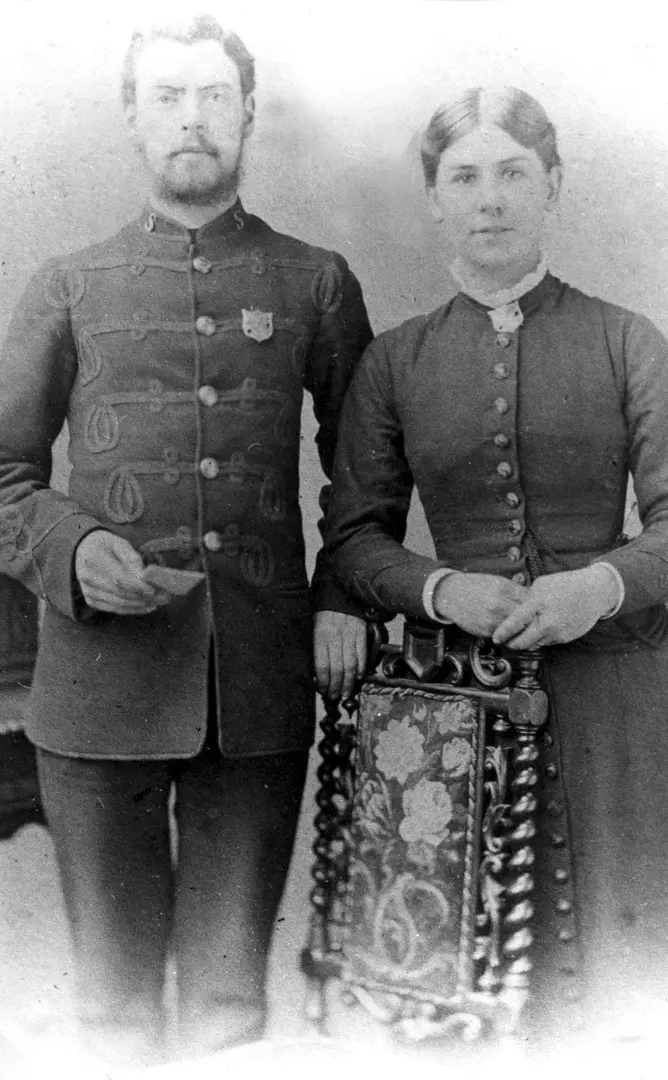
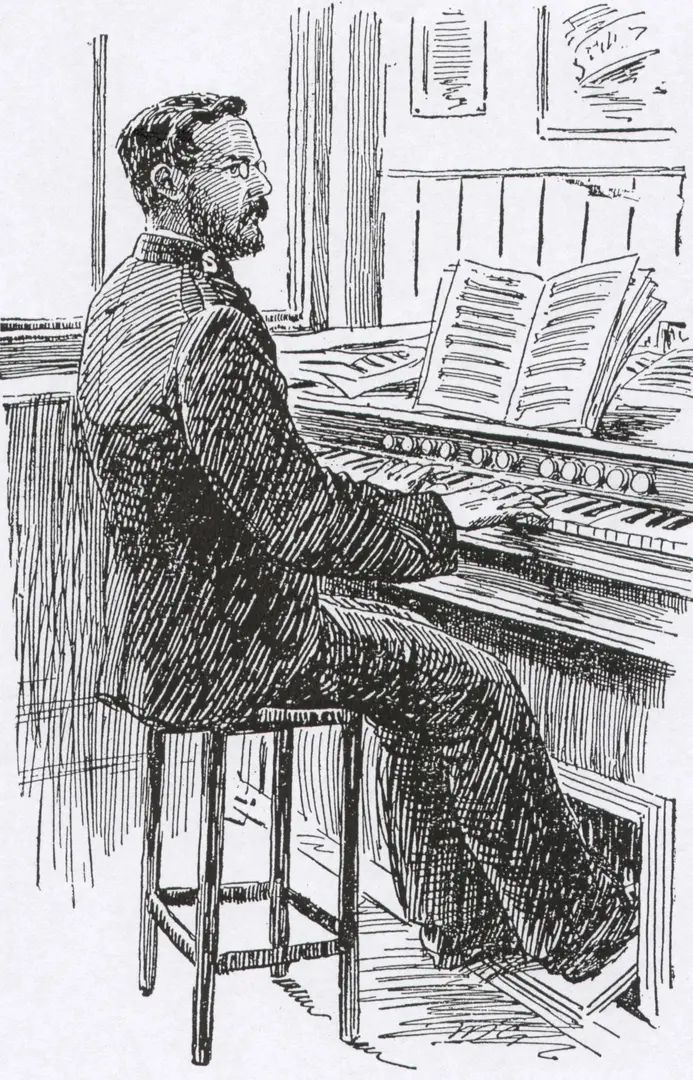
In this image of Slater and his wife Eliza, he is smartly turned out in his Army uniform. A young man in his prime. Eliza had an attractive singing voice, and sang many of her husband’s early songs in public.
2. Towards 'The Musical Salvationist'
On 14 October 1882, William Booth spoke to Slater about a possible appointment in the Army. The next day it was agreed that he should undertake musical duties for a wage of twenty-five shillings per week.
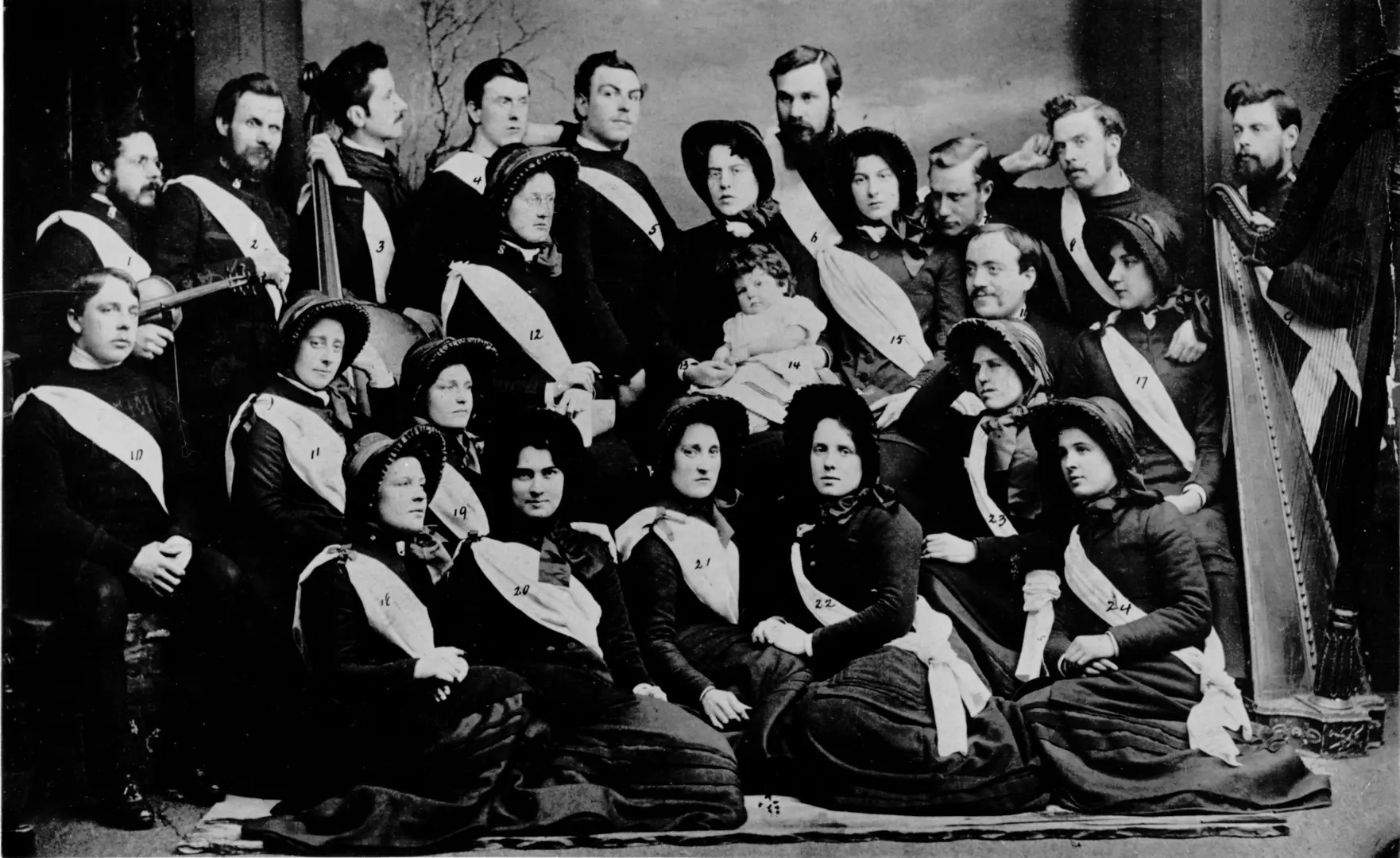
One of his tasks was to find individuals with good voices to form a singing brigade, the Salvation Songsters. He recruited them from the Army’s Training Home and taught the new songs that were to be featured in evangelical tours of the country. Many were written by Slater. Here we can see him on the left with his violin.
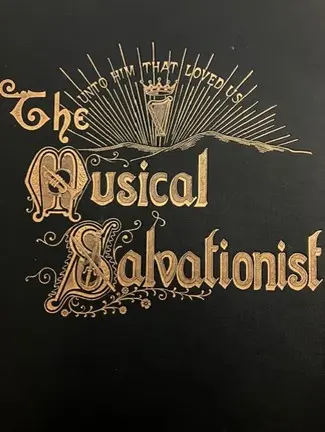
In May 1886 The Salvation Army held its first International Congress in London. New songs flooded in from many parts of the world. Consequently, a musical magazine was launched in July called 'The Musical Salvationist' under the editorship of Richard Slater. The first monthly edition contained just over a hundred songs. Slater contributed seventeen with both words and music, three with words only, and three just with music. He was to work on 'The Musical Salvationist' for almost thirty years until his retirement in 1913 due to ill-health. It was one of his finest achievements.
3. Slater the Songwriter
Slater composed over 500 songs for the Army. I will focus upon three aspects his work: one of his ‘Services of Song’, four devotional songs, and his use of secular tunes.
Service of Song
Slater composed several ‘Services of Song’ each of which include a connected story by means of readings and songs. I have chosen 'The History of The Salvation Army' published in April 1893. The ten songs are all by Slater, and are accompanied on the piano. I have selected six of them to comment upon.
The opening song is a tribute to 'The General' in four-part harmony. It was William Booth who had appointed Slater to work in the Army. Stately in tone, the song traces the leader’s journey: “he from Nottingham at length to London’s millions came”. In contrast to the verse, the rousing chorus “God bless our Gen-er-al” is directed to be sung fortissimo.
Slater next portrays the crowds of 'Mile End Waste' in London’s East End, where “Our Gen-er-al long’d that he might save them”. It’s a lyrical and expressive treatment, enriched by the piano accompaniment which adds harmonic colour to the simple melody. The refrain gently reminds that “Jesus loves you”. In contrast 'The Army Converts and Soldiers' moves at a lively pace, emphasised by a new jaunty time signature in 6/8. The song celebrates that in the Army Hall, “The drunkard, the liar, the swearer, the thief, and the cruel wife-beater, have there found a place”. The song builds up to its finale, “Oh glory, glory, glory unto the Lamb”.
'The Social Wing' is more reflective and considers the poorest who exist “In dark wretched dwellings, whence all hope seem’d fled”. Part of the answer was to establish Shelters and Workshops, so that “They hear that there’s hope”. The chorus is set at a livelier tempo, “Tis true that the Lord is the sinner’s best friend”.
Many converts became full-time officers in the Army, and in the final verse of 'The Officers of the Army' Slater celebrates the role of women: “God bless our warrior women! For sinners they are winning”. An exciting build-up to the chorus introduces a lively ‘running bass’ in octaves on the piano erupting in “March on, march on to victory and glory”.
Finally, Slater pulls out all the stops in 'The Army Music'. It’s loud, fast, and sung in unison. The accompaniment brings in fanfare figures, and tricky arpeggios to celebrate that “Army bands in many lands have led the lost to God”.
This ‘Service of Song’ shows Slater at his most versatile. The songs cross a spectrum of styles whilst communicating the fundamental beliefs of the Army.
Devotional Songs
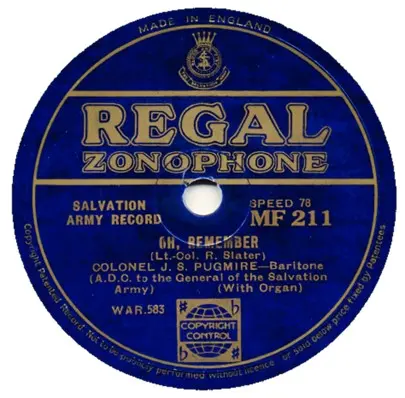
In contrast I turn to four of Slater’s devotional songs recorded on the Regal Zonophone label in the 1930s. They provide a different lens through which we can appreciate Slater’s songs within the performing traditions of a near century ago. They can all be accessed online at www.regalzonophone.com. Side by side with my own comments are some observations by Slater’s first biographer Arch R Wiggins, who knew him personally.
The song 'Oh Remember 'was recorded in 1931 by Colonel J S Pugmire (Aide-de-Camp to the General). His fine baritone voice is accompanied on the organ in a soulful performance. Pugmire takes his time over the musical phrases. There’s no rush. It was regarded as one of Slater’s most outstanding songs, with a chorus heard in many a prayer meeting.
In 1934 the well-known Songster Leader, Sam Hooper, recorded Slater’s 'I think of all His sorrow', tastefully accompanied by a piano trio (piano, violin and cello). His deep bass voice suits Slater’s personal response to Christ’s Passion: “’twas all for me”. For Colonel Edward Joy, himself a song writer, a key personal memory was listening to Slater singing the song from its original manuscript and accompanying himself on the harmonium.
Three years later Mrs Adjutant Coulter set down Slater’s 'To heal the broken heart'. Like Hooper she’s accompanied by a piano trio. Her voice has a wide range. She uses some portamenti, sweeping between one note and another, and takes some rhythmic liberties with the chorus. But it’s an effective interpretation of Slater’s beautiful setting. It was Slater’s daughter, Brunnhilde, who on a trip to Japan came across her father’s song being sung by some missionaries in a prayer meeting, unconnected with the Army.
My last example of Slater’s devotional songs is 'The Saviour Chose a Lowly Place'. Recorded in 1935 by the Congress Hall Songsters and the [Salvationist] Publishing and Supplies Band, it is reflective in mood with the songsters singing in four parts. In the chorus there is an effective call and response between the high and low voices, “Bending Low, [Bending Low], Seeking so [Seeking so]”. The song has the distinction of being the first Christmas song written by a Salvationist, combining words and music. It was chosen for Slater’s memorial service in the Regent Hall in December 1939. He had been ‘Promoted to Glory’ on 7 December 1939.
Secular Tunes
Finally in this discussion of Slater’s song writing I turn to his hunt for well-known secular tunes to be incorporated into the Salvation Army’s song repertoire. He focused on opera and national songs.
Slater loved French and Italian operas and on numerous occasions adapted arias and choruses to his own religious texts. In the very first song in the first volume of 'The Musical Salvationist' we find Slater’s somewhat loose adaptation of an aria from Auber’s popular opera 'Fra Diavolo' (1830). Whilst the English translation of the aria’s title is “On yonder rock reclining”, Slater substitutes 'While in my Lord Confiding'. Perhaps he was making a point that popular operas could provide a fruitful source of melody for Army songs. He made numerous operatic borrowings from composers including Bellini, Verdi and his beloved Wagner amongst others.
In his earlier life as a lecturer in Working Men’s Clubs, Slater spoke often about the importance of the National Songs of different countries. In his unpublished manuscript, ‘Classified Thoughts and Facts,’ Slater listed twenty or so national songs to which he had provided suitable words. I select six to illustrate, with Slater’s song titles on the right:
‘Barbara Allen’- The Streams of Living Water
‘Caller Herring’- Who will Love My Saviour?
‘Rule Britannia’- Rule Jehovah
‘The Bonny Banks of Loch Lomond’- The Many Joys of Salvation
‘The Last Rose of Summer’- For Mercy Apply
‘Tom Bowling’- Leaves from the Log
In these adaptations from opera and national songs, Slater was demonstrating his support for William Booth’s statement “I rather enjoy robbing the devil of all his choice tunes”.
4. Reflections
In his first volume of ‘Classified Thoughts and Facts’ Slater becomes self-critical: “I do not put very much value on my compositions, for it is in small forms, elementary in design and most of it planned to meet the restricted requirements of the Army” (July 20, 1905, p151). He regretted that “I have not had the benefit of criticism on my songs from persons of any special capacity to gauge their real value” (16 January, 1904, p380)
But more often he expressed pride in his achievements. He was by nature an enumerator. In his book, Salvation Army Song Writers, he reckoned that he had “supplied the words of 128 songs, in 132 more the music; and in 269 more the words and music: a total of 529 pieces”. In the more private pages of his ‘Classified Thoughts and Facts’ he confided that “perhaps about one third of what I have done in the Army will give me a place amongst its best composers and a place in its history” (20 July 1905, p419).
In spite of some personal misgivings about his own work, Slater believed in the power of song as an evangelical force. He pointed to the thousands who had been converted through the influence of Army songs. It was this that motivated him and lay behind his reputation as the Salvation Army’s ‘Song Writer Number One’.
Dr Gordon Cox
October 2025
Call the (Salvation Army) Midwife
In 1894, Salvation Army midwives began providing maternity services to mothers in their own homes in the East End of London

The Empress of Ireland
Many Salvationists lost their lives in the worst peacetime maritime disaster in Canadian history

The Life Saving Organisations
The Salvation Army has been linked with Boy Scouts and Girl Guides from the early days of Lord Robert Baden-Powell’s initiative.

The Navy and the Navvy: Wales 150th anniversary
2024 was the 150th anniversary of The Salvation Army in Wales. Here's how we celebrated...