International Heritage Centre blog
Guest blog: Black History Month 2025
Guest blog: Black History Month 2025
Our guest blog this month is from Winette Field, William Booth College Librarian, who looks at the origins of Black History Month and some of the complexities she has encountered in her historical research.
Black History Month was first commemorated in the UK in 1987. Its aim was to challenge racism and celebrate the history of Black people. The prime mover, Akyabba Addai-Sebo, said that he "conceived an annual celebration of the contributions of Africa, Africans and people of African descent to world civilization from antiquity to the present and got a lot of support from the leadership of the GLC and ILEA". His plan was bold and used October simply because it is near the start of the school year. It was embraced by leaders of both the Greater London Council and the Inner London Education Authority (ILEA), eventually spreading across British society more generally.
From a movement developed to boost respect, it has flourished into an opportunity for all to learn about history, for the story of Black history is ultimately the story of the world; there cannot be one without the other.
The UK in the late 1800s had about 15,000 black people in port cities, market towns, and villages [Historic England]. Amongst their professions were sailors, tradespeople, musicians and servants.
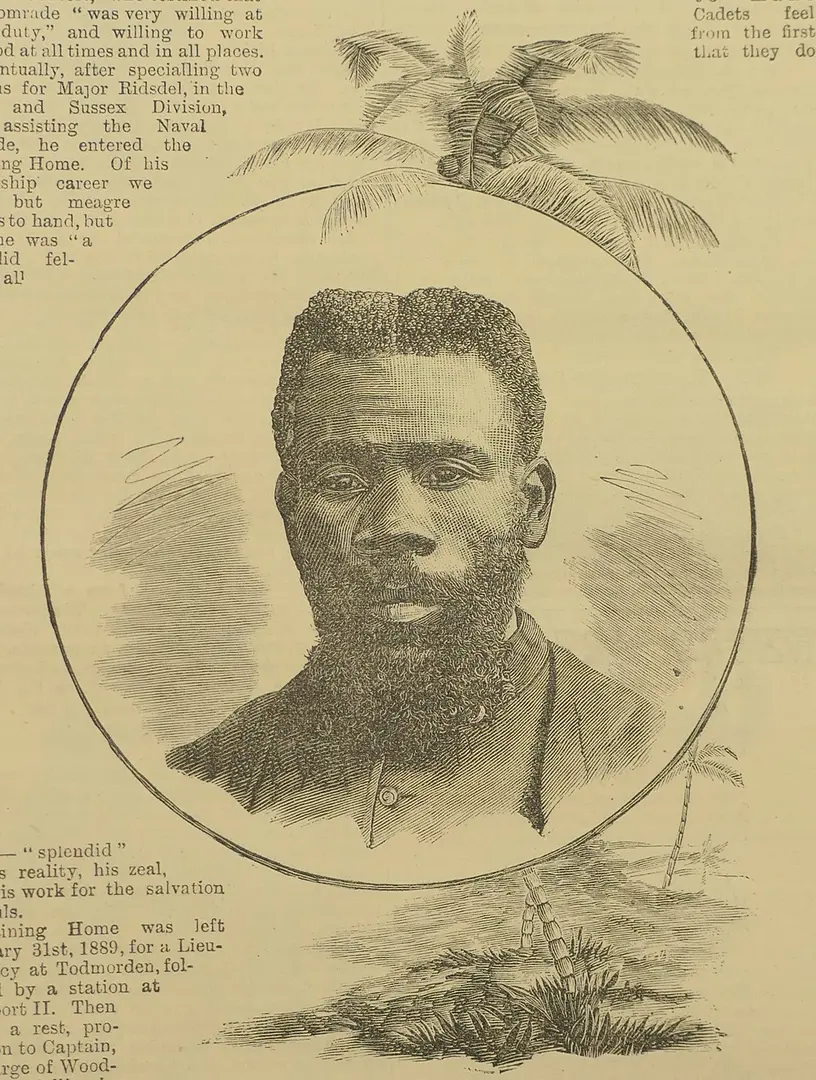
In doing historical research, one faces many challenges. First, and foremost, is the complexity of those hidden in plain sight—the men and women whose names do not necessarily identify them as people of colour. One such person was William Daniel Woods, born in St. Kitts around 1856, who entered training to be a Salvation Army Officer after serving with its Naval Brigade in Kent and Sussex in 1888.
He was appointed Lieutenant at Todmorden in January 1889 before going on to work in Newport II, Woodford and Kettering Division. He died in January 1890, and in 'The War Cry' of 8 February 1890, Woods' obituary featured a portrait which is how we know he was black:
Physical descriptions are used in some instances but not all:
“Mr Hamilton preached. Six came upon the stage seeking mercy. One, a black man, who had been to the open-air meeting all day, and had listened very attentively; he had been getting his living conjuring and the like in public houses; now he was convinced that he was wrong. ……Hallelujah to the Lamb, He can save men of all nations, and of every colour” -East London Evangelist, September 1869, p186.
However, here we meet another difficulty in that some descriptions contain harmful language or represent harmful attitudes of the time:
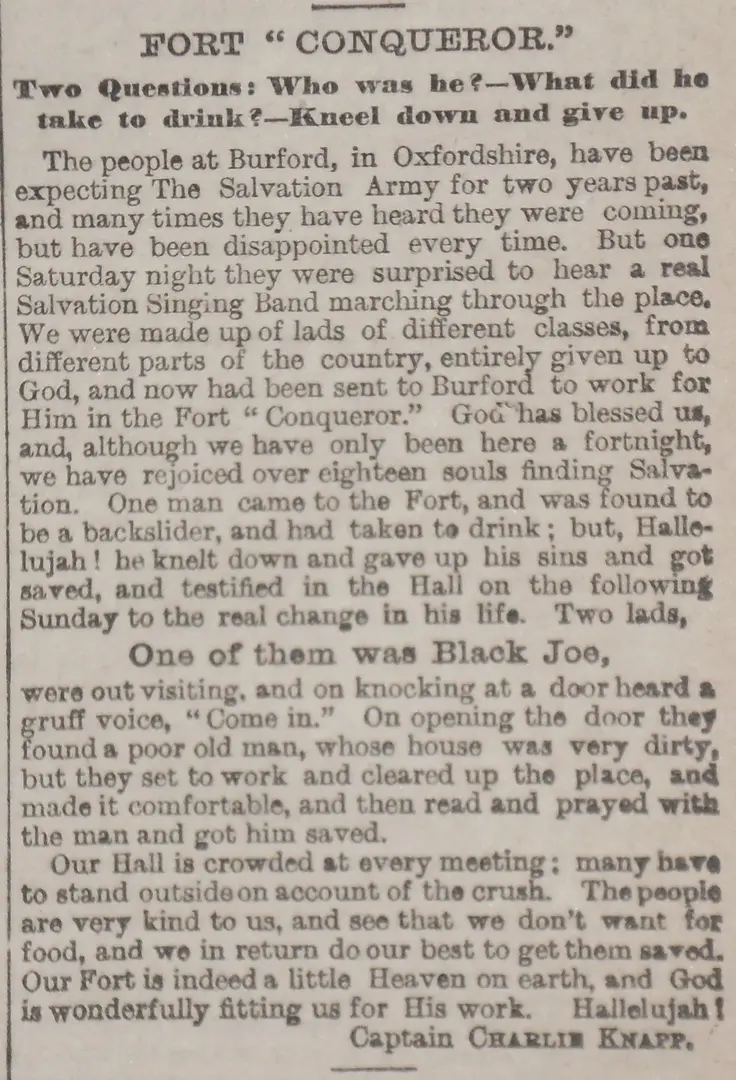
The problem of language can also be linked to the desire for a catchy headline. Thus, Samuel Marshall became ‘The Barbadoes Shoemaker’ in the pages of 'All the World' for June 1896. But one did not have to be a person of colour to fall foul of labelling: Nishan Der Garabedian, on moving to the USA, changed his name to Joseph Garabed only to be nicknamed “Joe the Turk”.
The third challenge involves pictures. They are a good indicator of ethnicity, yet they do not tell us where a person came from or why. Indeed, the image presented may not be real, either being overly flattering or playing to a stereotype. One also needs to question who gets photographed and why, and how the image is being used.
The Salvation Army cadet training records contain headshot photographs of most of those entering Salvation Army training. These were to aid the staff in identifying who each of the students were.
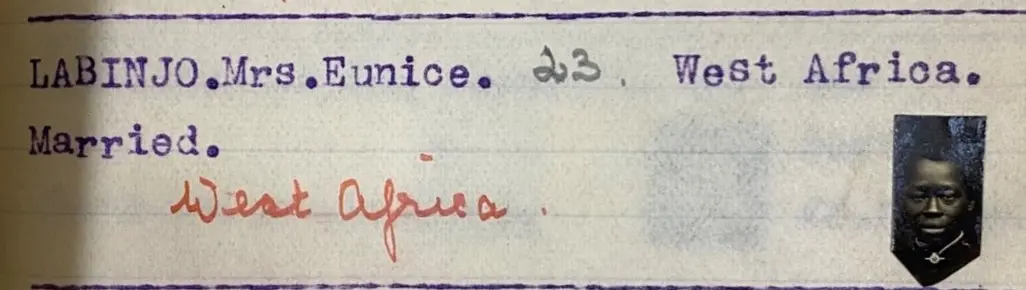
Eunice Labinjo entered from Nigeria having married the day before her departure for London. She and her husband, Oladipo, were described as having the first "Hallelujah" (Salvationist) wedding in Nigeria, and they went on to pioneer work at Egwana, Port Harcourt and Calabar.
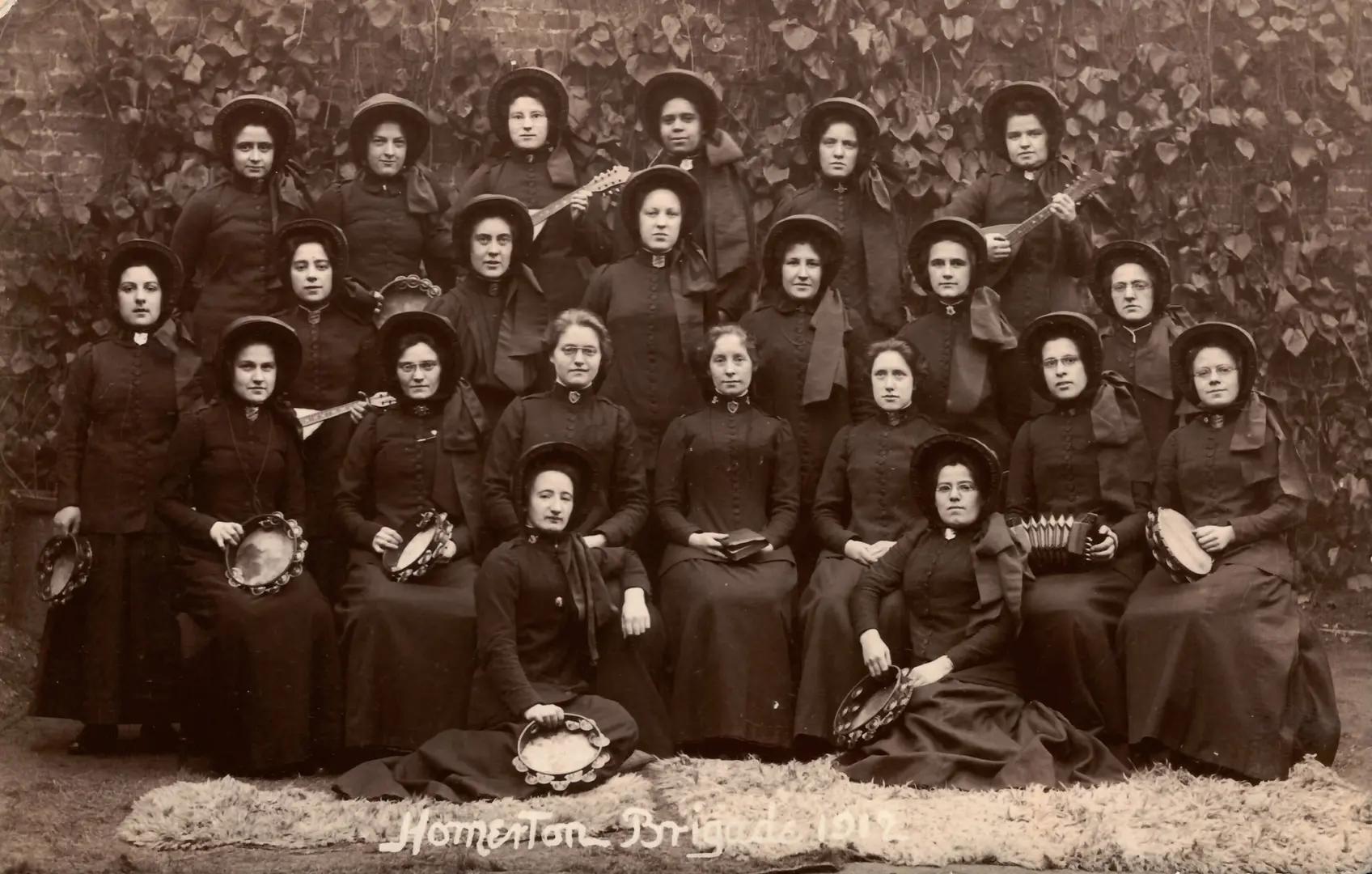
Another cadet, E. Wilson (centre back), entered training from St. Albans in 1911 and was described as having a "West Indian" father. Wilson was in her early twenties but identifying her within the 1911 census has so far been impossible.
Salvation Army Officer career cards are also a good way of identifying people of colour as they usually have a photograph. Aston Davis was commissioned in Kingston, Jamaica, but served at William Booth College from 1939-1940. He returned to Jamaica to serve in the Jamaican training college before being appointed to work in Belize from 1940-1947.
There may be obstacles, but its worth seeking out the stories of those who went before and adding to the day to day discourse of the places we call home. Black History Month is for all, an opportunity to seek out stories like these from history that are hidden in plain sight all around us.
So what can you do? Why not visit your local history library or an archive like the Salvation Army International Heritage Centre and see who is connected with your area.
Winette
October 2025
Read other blogs from the Heritage Centre
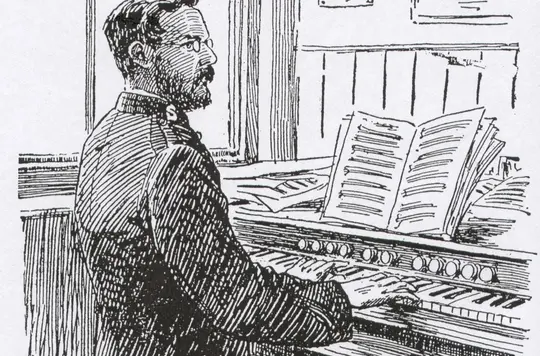
Richard Slater: The Army's ‘Song Writer Number One’
Our latest guest blog by Dr Gordon Cox is an introduction to Slater and his songs.
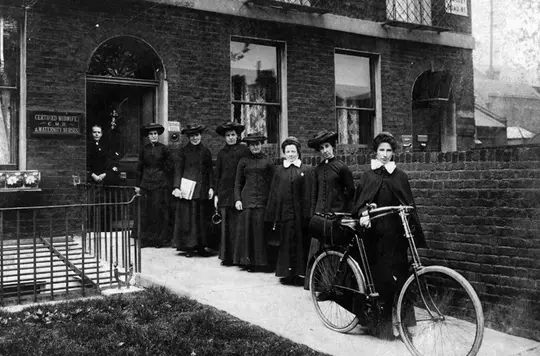
Call the (Salvation Army) Midwife
In 1894, Salvation Army midwives began providing maternity services to mothers in their own homes in the East End of London
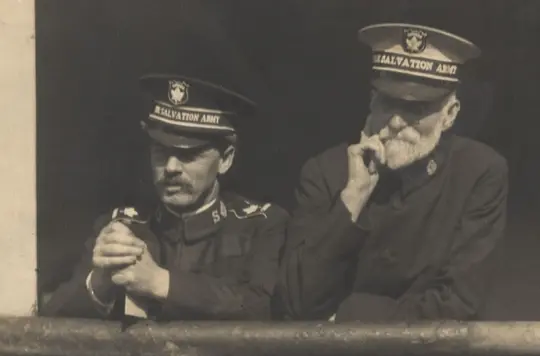
The Empress of Ireland
Many Salvationists lost their lives in the worst peacetime maritime disaster in Canadian history
The Life Saving Organisations
The Salvation Army has been linked with Boy Scouts and Girl Guides from the early days of Lord Robert Baden-Powell’s initiative.