Working people now in food bank queues warns Salvation Army
published on 5 Sep 2025
Working people now in food bank queues as everyday costs continue to soar
Ahead of National Food Bank Day (Friday 5 September), The Salvation Army across the north west is warning that rising household bills and food price inflation is pushing more people into poverty with many of its food banks now seeing working people at the front of the queue.
The Salvation Army in Preston, Lancashire, continues to see an increase in demand with more clients now being in full or part time work as food prices and household bills remain high. Salvation Army officers in Liverpool, Merseyside, and Penrith, Cumbria, also echo this trend.
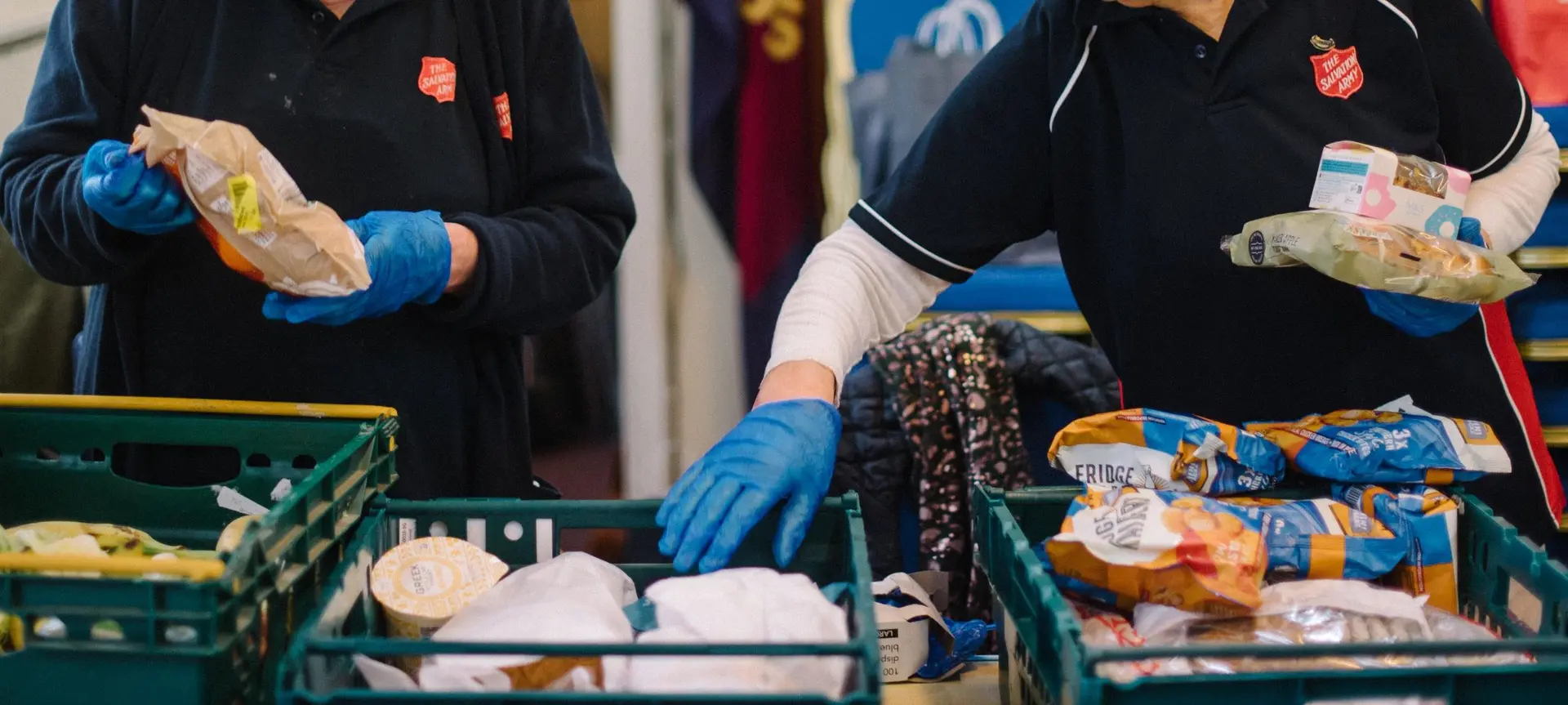
And along with food banks, some Salvation Army churches across the north west are providing food support in innovative ways including access to food clubs, food banks operating on a self-referral process, specific choice of food items and overnight emergency food support when food banks are closed, relieving the pressures when finances are stretched and when referrals are not easily accessed by people in employment.
Aliyah* from Greater Manchester is a nurse working part time in a hospital and her husband works in sales. They live with their three children and access the food services of their local Salvation Army. She said: “I’m always cautious of how much I spend, I have to be, the cost of living is just too high. I’ve learnt over the years to manage our family finances, just to keep up with life. I’ve had to do that because money, wages, it just doesn’t keep up with the pace of the rising cost of living. Every week it can be a juggle. My husband and I both work to provide for our family and we still don’t have enough money.
“I come to the food club every week and it does make a big difference. The food club gives me the freedom to choose what I need and pay affordable prices meaning my family doesn’t suffer.”
Through its food banks, The Salvation Army provides key cupboard staples and non-perishable food items such as tinned potatoes, pasta and long-life milk, but officers on the front line are now finding the need to provide toiletries and household essentials too like shower gel, deodorant and toilet paper as more households now require support outside of basic food needs.
Claire Bowerman, community centre manager at The Salvation Army in Preston said: “Food banks should only ever be an emergency response, but food is expensive. Food poverty is real, and people are relying on food support more than ever before. The need for wider support is also real, and we are here to help, and we are finding we are helping more people than ever.
“There is no typical food bank user anymore with people’s situations so varied. We see people use our service who are in work, but their rent or mortgages have increased so much that they can no longer afford food in order to keep a roof over their head. We see people who are unable to work and who cannot cover all outgoings with the benefits they receive, and we see families, scrambling to ensure their children have three meals a day. NHS workers, homeowners, teaching assistants, people claiming disability benefits; we are seeing that anyone can be in a desperate situation and needing a helping hand.”
The Salvation Army has over 600 community churches with many seeing first-hand the devastating impact of ever-increasing food, rent and energy prices, historically on households with the lowest of incomes but now even from people in employment.
For anyone who wants to donate to a Salvation Army foodbank, please check which local churches run them using this map: www.salvationarmy.org.uk/find-a-church
To make a general donation towards The Salvation Army’s work supporting people through the cost-of-living crisis please go to www.salvationarmy.org.uk/donate
